Penn Station Fire and the Value of an Emergency Plan
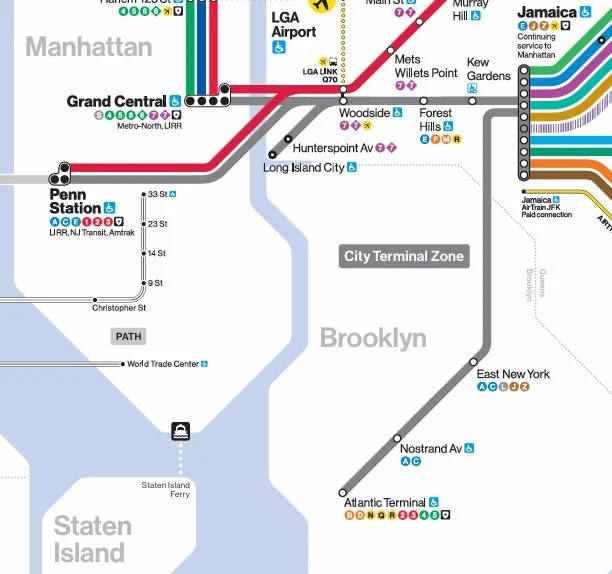
A map of the LIRR’s alternative terminals (Image: MTA)
On Thursday, May 14, a midday fire knocked out two of the four East River tunnels that the Long Island Rail Road uses to access Penn Station. Because one additional tunnel was closed for a long-term overhaul, this left only a single track for all trains between Penn Station and Long Island during May 15th’s AM rush. This has caused massive disruptions: at first, the LIRR suspended most service west of Jamaica. Since then, the railroad has begun to divert some trains to Grand Central Madison (GCM) and Atlantic Terminal as it very slowly resumes operations to Penn Station.
Before going further, it is important to note that this is not an ordinary week for the LIRR. The railroad is preparing for a possible strike beginning at Midnight, which should it not be called off at the last minute would prevent any trains leaving terminals as of that time. This further complicates the situation by requiring the agency to modify schedules and make other preparations to ensure that trains are in locations that permit for a rapid resumption of service if the potential strike ends. For more info on the strike, the LIRR has set up an information page with final trains, and alternative service. ETA encourages straphangers to keep an eye on LIRR social media and alerts for the latest strike information.
Fires and other severe disruptions are thankfully rare, and ETA is happy that no one has been injured. At the same time, thanks to its redundancy, the LIRR can and should develop emergency service plans that can be implemented on short notice for major disruptions like this [1].
This is not unprecedented. Trains on NJ Transit’s Morris & Essex, Montclair-Boonton, and Gladstone Lines that normally run into Penn Station via MidtownDIRECT are being diverted to Hoboken Terminal under an emergency operations plan. From there, riders can take PATH, buses, or ferries to and from Manhattan. NJ Transit also maintains a webpage for information about alternative service options for each station.
The LIRR has four NYC terminals that can take full length trains: Penn Station, Grand Central Madison, Atlantic Terminal, and Hunterspoint Ave. After the fire, the LIRR has only diverted some trains to Grand Central Madison and Atlantic Terminal, with the rest terminating at Jamaica, where passengers are expected to transfer to the E, J, or Z subway lines.The E, however, is already overcrowded in normal conditions, and the J/Z only offer a long, slow ride to Lower Manhattan, not Midtown. Per the MTA status page, the LIRR has minimally diverted diesel branch trains to Hunterspoint Ave, and has not to the station past Hunterspoint Ave, Long Island City, which can not take full length trains. Significant numbers of trains in the reverse-peak direction were cancelled, or truncated at Jamaica.
By sending trains to its other terminals, the LIRR could offer the following connections:
To Atlantic Terminal:
2/3/4/5/B/D/N/Q/R at Atlantic Terminal
A/C at Nostrand Ave
L at East New York
To Hunterspoint Ave and Long Island City:
E/F/M/R at Forest Hills
7 at Woodside
7/G at Hunterspoint Ave
7 at Long Island City
To Grand Central Madison:
4/5/6/7/Times Square Shuttle At Grand Central Station
Metro-North Railroad at Grand Central Terminal
This emergency operation would offer Long Island riders transfers to every subway line except the 1, the Franklin Avenue shuttle, and the Rockaway Park Shuttle.
The $11 billion Grand Central Madison was a questionable piece of transportation planning, as it split service into Manhattan two termini [2]. The one clear advantage of this set up, however, is that it provides redundancy in case of disasters like this. Grand Central Madison was designed to easily handle 24 tph (trains per hour), but even in these emergency conditions, the LIRR was not running a full complement of trains to its only active Manhattan terminal. Indeed, for today’s PM rush, the railroad was only showing 10 tph from 4-5 pm, 15 tph from 5-6 pm, and 12 tph from 6-7 pm, on to TrainTime as of mid-afternoon on May 15th [3]. It then placed a number of diversions on the status page on mta.info with notes that other trains going to Penn Station are cancelled.
Of course, a major railroad like the LIRR cannot completely change its schedule and operations on a moment’s notice: schedules are written assuming that trains and crew will be in certain places at certain times. Given the amount of redundancy in the LIRR system, however, it would be prudent for the MTA to invest in emergency plans that can be activated on short notice for major incidents affecting either Penn Station or Grand Central. While such irregular operations would require significant changes to crew schedules on short notice, the trade-off would be worth it to maintain as much service as possible during disasters like these.
Footnotes
These plans for the evening would be potentially affected by strike preparations.
This effectively halved the frequency of service that can be offered to each terminal.
According to TrainTime, on 5/15/2026, from GCM-Jamaica, there are 7 tph from 4-5 pm, 13 tph from 5-6 pm, and 10 tph from 6-7 pm. From GCM-Great Neck (Port Washington Line), there are 3 tph from 4-5 pm, 2 tph from 5-6 pm, and 2 tph from 6-7 pm.