Through-Running: First Connections
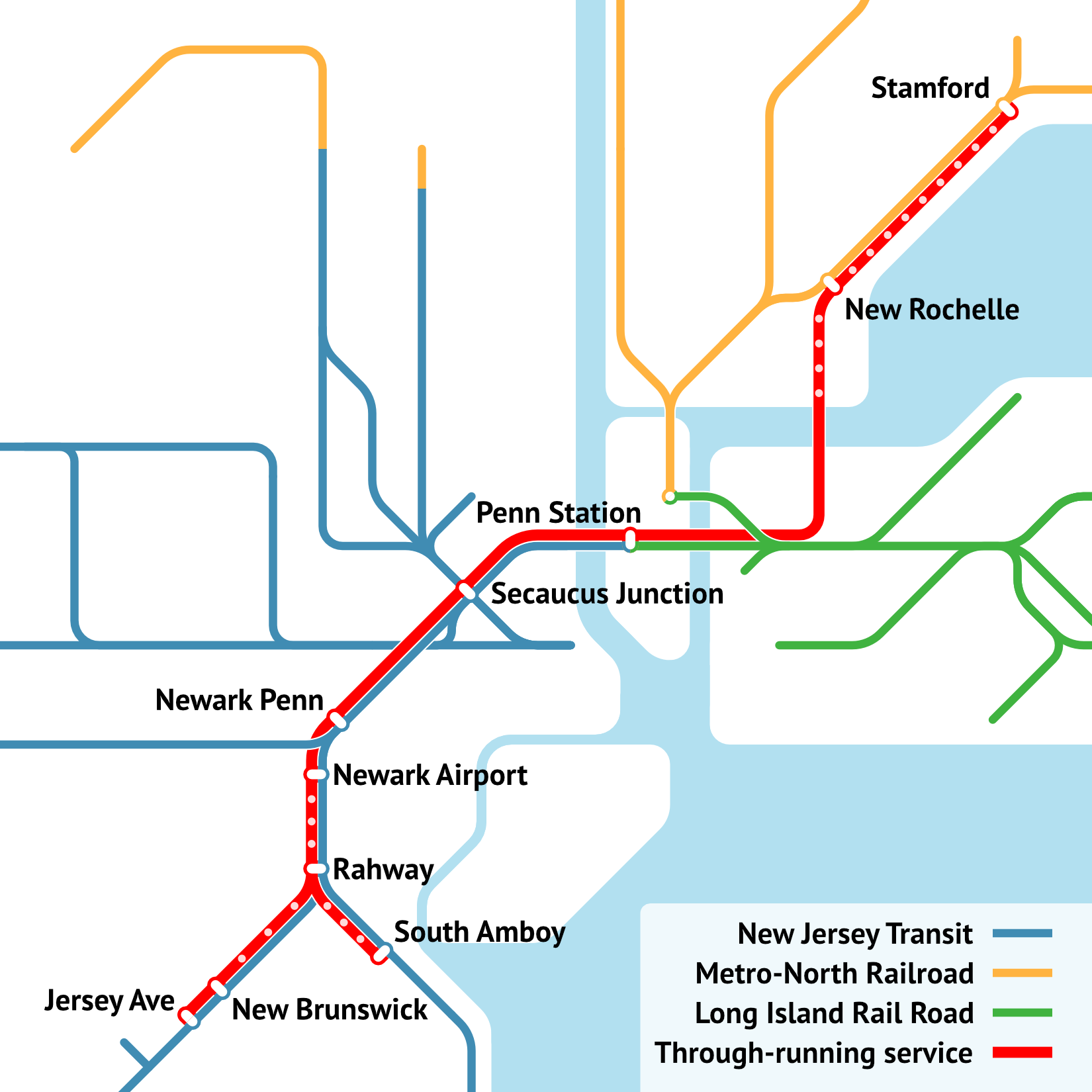
New York’s commuter rail systems, with initial through-running service from Jersey Ave and South Amboy in the south to Stamford in the north. Diagram credit: Kara Fischer, ETA
First delivered 2025
Released Publicly:
May 4, 2026
Table of Contents: Executive Summary | Preface | Phase 0: Bring Back the Train to the Game | Phase 1: Through-Running for Penn Station Access | Phase 2: Early 2030s | Phase 3: Through-Running for Gateway | Phase 4: Expanding Through-Running with Future Infrastructure | Penn Station Renovation | Appendix 1: Project Timeline | Appendix 2: Port Washington Turning Capacity
Editor’s Note: This report was prepared in mid-2025 for a regional stakeholder, before it was clear that that Penn Station through-running was being seriously explored. While some of the details may have changed—for instance, it is too late to start through-running service for the 2026 World Cup—the fundamentals of this proposal remain the same today.
Executive Summary
It’s clearer than ever that Penn Station needs more train capacity. Thankfully, there is no need for a costly and destructive expansion to run more trains. Instead, the region can dramatically improve the capacity of the existing station by running both MTA and NJT service through Penn. Through-running will not only allow Penn to make full use of the new Gateway tunnels, but will connect the Tri-State area in new ways, turning difficult regional trips today into easy and fast commutes tomorrow. Best of all, through-running can essentially start immediately, with no major changes required to Penn Station.
Through-running decongests Penn Station in a few interrelated ways:
Trains don’t sit and waste time: When trains don’t need to load or unload all their passengers, they don’t need to dwell as long at the platform.
Trains flow through Penn: Reversing trains is slow and conflicts with arriving trains.
Scheduling is simpler and easier: More trains can use the same platforms.
Through-running is superior to alternative ways of decongesting Penn Station because it:
Makes for better service than alternatives by connecting more destinations faster.
Costs less money than alternatives by getting more out of existing infrastructure.
Through-running is the global best practice for modern commuter rail at large central stations. European transit agencies frequently deem it so valuable that they are willing to spend billions of dollars to accomplish what NY can already do today.
By building upon MTA’s Penn Station Access (PSA) project, the MTA and NJT can begin doing this with no new infrastructure or equipment beyond what is already planned:
Service: After a learning period, PSA begins, through-running with NJT locals from Jersey Ave, New Brunswick, and South Amboy. Through-running is expanded to additional lines in the future.
Infrastructure: PSA’s improvements north of Penn provide a great starting point for through-running that future regional investments can build upon.
Crewing: Crews can switch swiftly at Penn with minimal additional training required. This works within current union agreements.
Equipment: Rolling stock must support both 60 Hz and 25 Hz catenary. NJT Multilevel IIIs are the best candidate, but other equipment can be used as well.
Fares: Through trips should be possible on a single ticket for a seamless passenger experience.
New York’s commuter rail systems, with initial through-running service from Jersey Ave and South Amboy in the south to Stamford in the north. Diagram credit: Kara Fischer, ETA
Preface
Penn Station is ready for through-running as currently constructed. Reconfiguring Penn’s operations for through-running costs far less than expanding the station, and would be transformative for the region.
ETA has carefully constructed an incremental through-running phase-in plan that doesn't risk cascading failures and sets up the agencies for success while they learn new ways of doing things and build a ridership base.
Our plan, in brief, by phase:
In Phase 0, we restart the Train to the Game by the World Cup, so agencies can resume working together in a lower-stakes setting.
In Phase 1, when Penn Station Access opens in 2028, we roll out all-day through-running to an initial set of routes between New York and New Jersey.
In Phase 2, we work through the backlog of small projects necessary to make higher-capacity service reliable by the early 2030s. As rolling stock compatible with all commuter rail systems arrives in the early 2030s, we add more through-running routes, including select LIRR lines.
Finally, in Phase 3, when Gateway opens, we lean on those small projects to dramatically expand through-running, boosting ridership through Penn Station far more than Penn Expansion could hope to deliver.
As an addendum, we include a Phase 4 showing further through-running extensions unlocked by future projects such PSA Phase 2 (West Side Access) and a hypothetical Penn–GCT connection, as well as some additional information regarding the overhaul of Penn Station and its overbuild.
This doesn’t mean that through-running would be completely without risk, however, even though it would involve far less risk than a major station expansion. Reliability is absolutely crucial: it directly increases ridership and indirectly raises speeds, increases frequency, and reduces costs, attracting even more riders. Through-running increases connectivity, so without any other changes, there is the slight risk of reduced reliability since failures can cascade across a much larger network.
The good news is that targeted operational measures and capital projects can pair with through-running to more than offset the slight risk inherent in a larger, more interconnected network. To help improve reliability, all three commuter railroads should investigate simplifying stopping patterns and speeding service by reducing unnecessary schedule padding, something Metro-North has already started on the New Haven and Hudson Lines. What’s more, through-running would itself boost network reliability at and near Penn Station. Taken together, these targeted projects would make it so that, while each failure may propagate farther, failures would be rarer, enough to deliver a large net reliability improvement. Better yet, these incremental capital projects would cost far less than any program of Penn Station expansion, while providing a far stronger improvement in regional transit connectivity.
There is also a trade-off between throughput and reliability. More trains per hour (tph) makes a failure within that hour more likely. That means that many of the projects we propose in lieu of Penn Expansion are necessary regardless of how Penn Station capacity is boosted. For example, the improvements to the CP 216 interlocking near New Rochelle described in Phase 2 are needed to reliably run more PSA trains regardless of the choice of Penn through-running, Penn Expansion, or any other Penn capacity plan.
There is an organizational aspect to the cascading failures, too. The MTA, NJT, and Amtrak are keenly aware of one another’s weak points, and less so of their own weak points. This leads to a railroading culture where through-running can seem scary to the agencies, because each agency can imagine some mishap on another agency's territory cascading onto theirs, and then the other agency not promptly addressing the issue because it's no longer their problem. For through-running to succeed, agency and political leadership will need to ensure that these institutional cultures start to change. Agencies will need to trust each other more and hold themselves to an even higher standard. On the political side, various little projects that have been deprioritized—since their value to isolated systems is marginal—take on more urgency, too, as they will now be essential for the new tunnel to deliver its promised throughput.
We have also included a section with recommendations for Penn Station Reconstruction with its recent federal takeover. It should prioritize increasing egress capacity from the platforms to the concourses, the primary constraint on shorter train dwell times. However, while additional changes are recommended, no station changes are required to implement through-running. The upshot is that, while through-running is more organizationally complex than current service, it permits high throughput and unlocks further investments in capacity and speed for very little capital spending.
Phase 0: Bring back the Train to the Game
Before Penn Station Access opens, it would be very helpful to iron out kinks with dispatching and onboard crews by bringing back the Train to the Game in time for the 2026 FIFA World Cup and continuing to run it thereafter for other games and events. With several games, including the final, being hosted at MetLife Stadium, effective rail service to the Meadowlands will be critical.
The aim is still to build Phase 1, as described below. However, the Train to the Game is an opportunity for train crews and dispatchers to get accustomed to through-running, including qualification on the stretch from New Rochelle to Penn. All Train to the Game preparation should begin as soon as possible, so that through-service can be tested with out-of-service trainsets in time for the Train to the Game to start running for next summer’s World Cup.
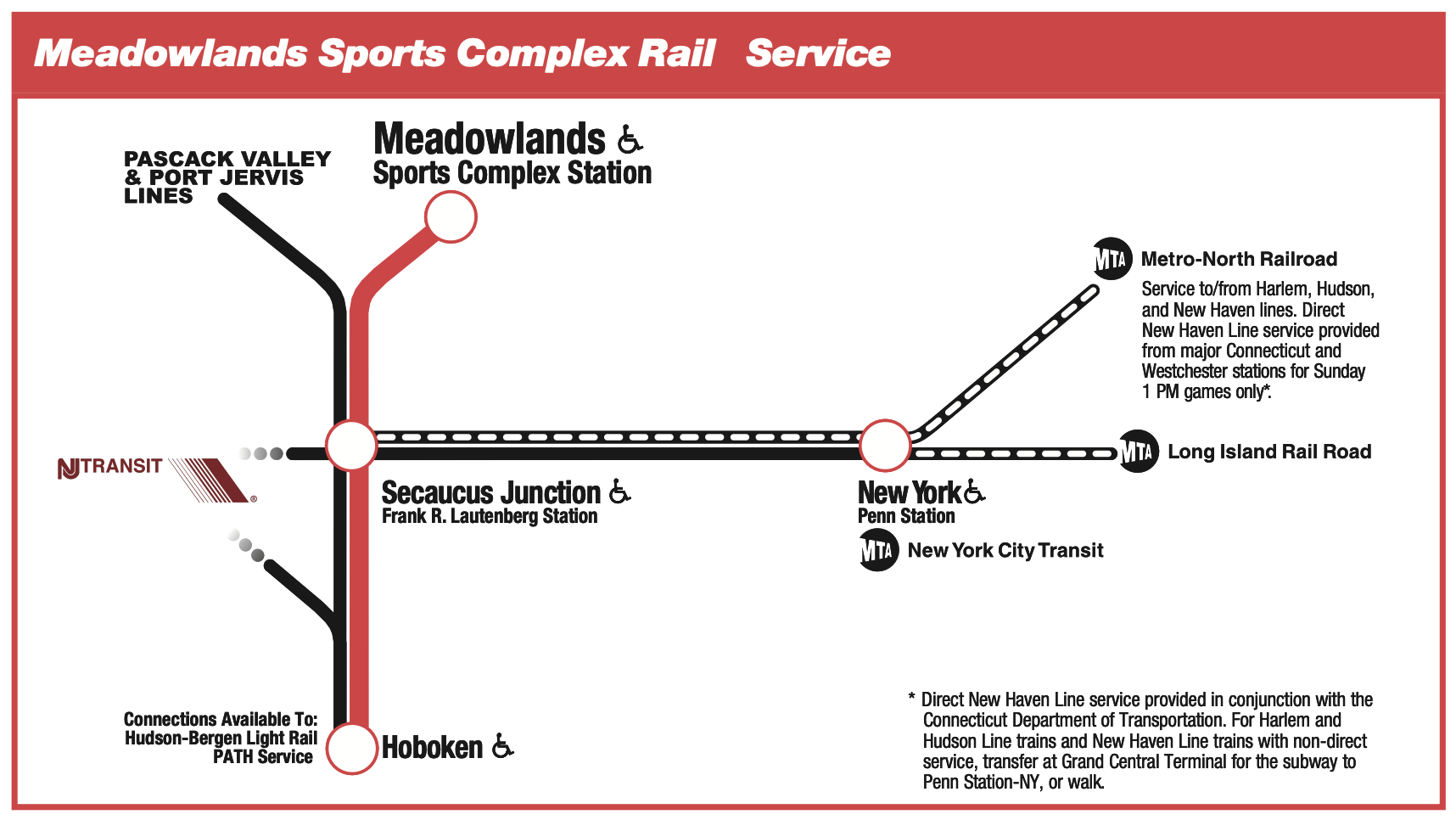
A route diagram from Metro-North’s Train to the Game service. Credit: MTA
Phase 1: Through-Running for Penn Station Access
When Penn Station Access opens in 2028, the region will be ready to begin through-running NJT and Metro-North service. As detailed in the following sections, only a few small operational changes are needed. Penn Station’s existing design does not require any changes in this phase.
Phase 1 implements through-running in regular service with as few operational and physical changes as possible. It boosts capacity in terms of passengers across the core, by converting slots currently spent moving trains to and from storage yards to trips that carry passengers. However, by itself, it does not boost trans-Hudson capacity beyond today’s 24 tph, as that capacity is limited by the double-track North River Tunnels (NRTs) until the Gateway tunnels open.
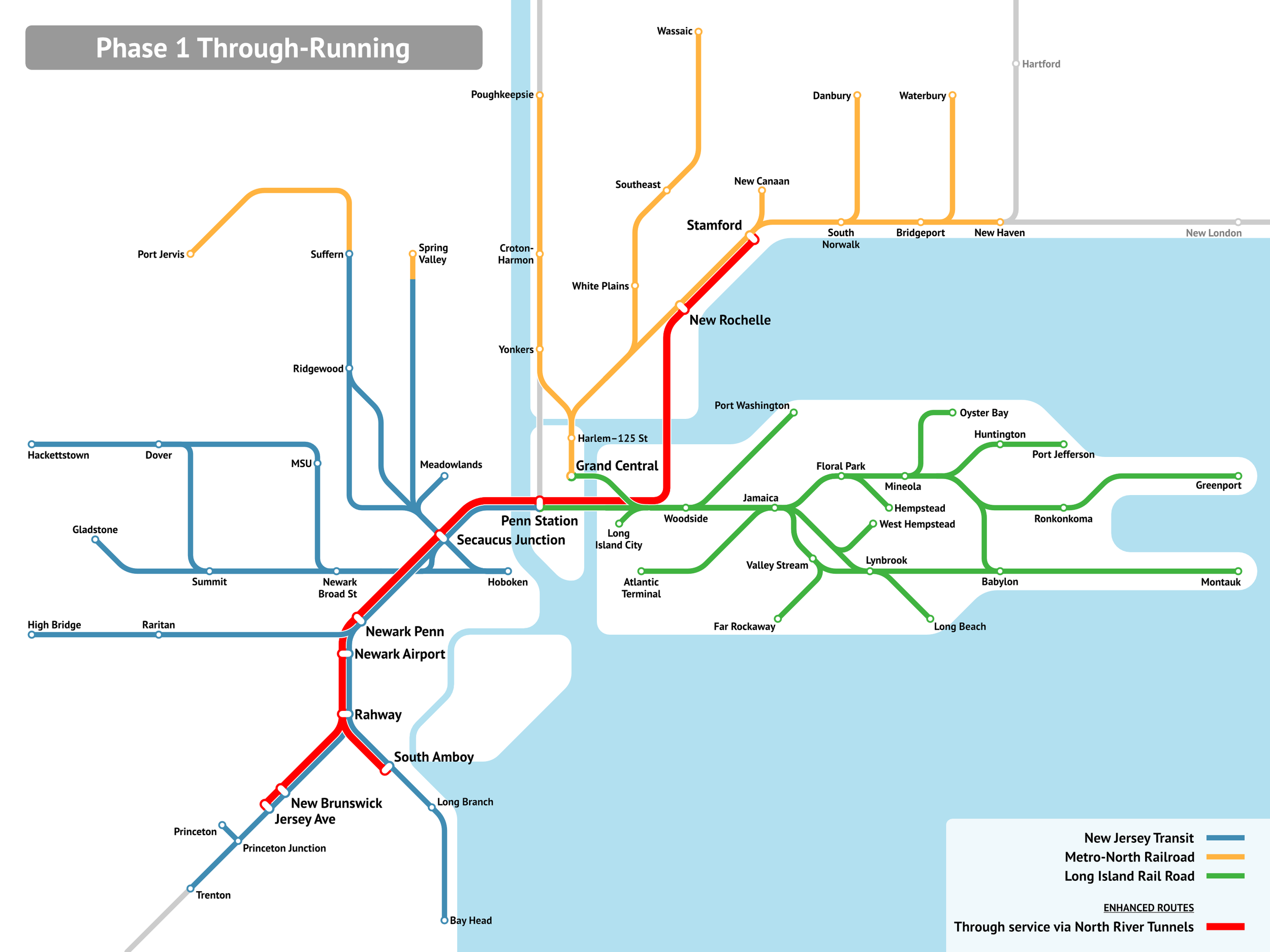
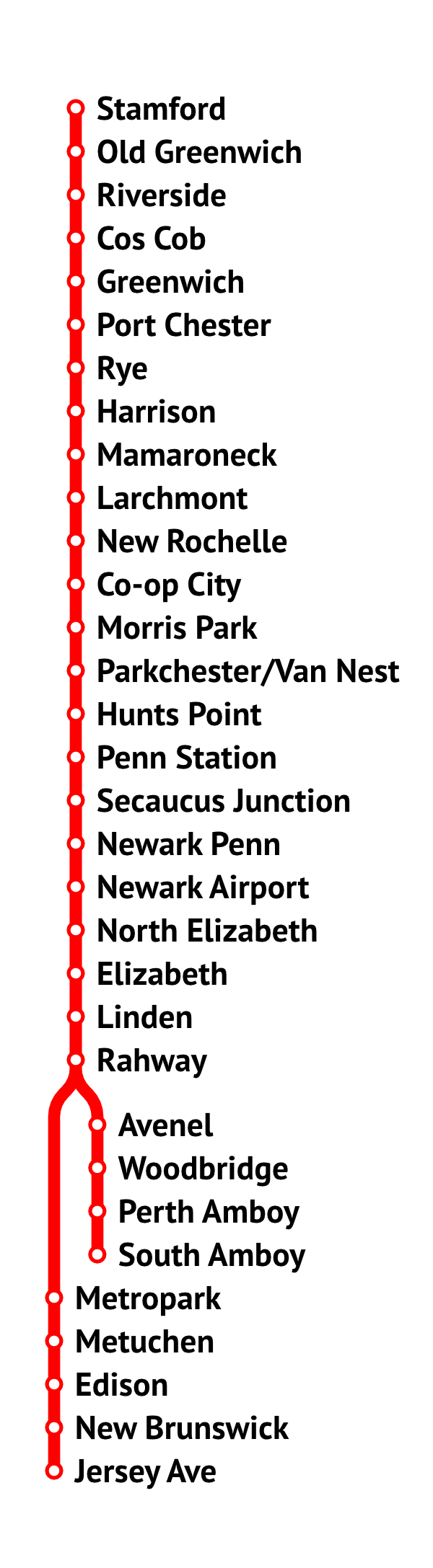
A service diagram (left) and strip map (right) of Phase 1 of through-running service. Credit: Kara Fischer, ETA
Service
In Phase 1, PSA trains through-run to the NJT local and semi-express trains on the Northeast Corridor (NEC) and North Jersey Coast Line (NJCL), terminating at Jersey Avenue, New Brunswick, or South Amboy. The current peak throughput on these combined NJT services is 7 tph. A service level of 6-10 tph peak and 4 tph reverse-peak has been planned for PSA, so the peak service levels on both sides are already similar.
Service should through-run off-peak as well, including on weekends, with a train every 10-15 minutes at minimum. This is in line with modern commuter rail across the world and transit across the US. The nearby 6 train, for example, runs every 6 minutes off-peak. These trains can then run as locals, providing the same frequency in dense inner suburbs in New Jersey, such as Elizabeth.
Rolling Stock
Once PSA opens, the limiting constraint on tph is rolling stock availability. In particular, trains need to run under both the 60 Hz catenary used on Metro-North and the Hell Gate Line and the 25 Hz catenary used on the NEC in NJ in order to through-run.
Fortunately, NJT equipment meets this requirement. Our proposal would largely convert train hours spent idle in Sunnyside Yard to time spent offering transit service connecting densely populated areas. We recommend using Multilevel IIIs if possible, as they are the newest and most powerful NJT rolling stock and would increase reliability. Additionally, several NJT Arrow III sets remain in service and can have their lives slightly extended until new equipment is in hand. Amtrak might also have electric locomotives available to lease in this timespan.
Metro-North plans to run some PSA service using catenary-battery hybrid locomotives. Since these locomotives can run on 25 Hz power into NJ, they can be placed into a pool with all the other electric equipment. Locomotive-hauled trains accelerate considerably more slowly than electric multiple units (EMUs) such as the M8s and even partial EMUs like the Multilevel IIIs. Most acceleration happens when leaving the station, so poor acceleration is less bad for trains that make fewer stops. We therefore recommend that locomotives only be used on express trains while the local services use Multilevel III EMUs, and if needed, NJT Arrow III EMUs.
Infrastructure
No new infrastructure upgrades are needed at Penn or at NJ stations yet. Revenue-to-non-revenue through-running trains (those discharging all passengers and continuing to a yard) would be replaced by revenue-to-revenue through-running trains, so no additional platform time would be needed.
Moreover, this route is already entirely electrified and almost fully high-platform, with the exception of Jersey Ave, ensuring high reliability and performance. Finally, it allows trains to avoid using the West Side Yard, which is only electrified with third rail rather than catenary.
Crewing
In order to through-run, the only additional training required is for operations and maintenance of any equipment that is new to Metro-North or NJT personnel.
To simplify union negotiations by leveraging existing agreements, crews can easily and quickly hand over trains between railroads at Penn Station. This is similar to what SEPTA does in Center City Philadelphia in 3 minutes. For over 20 years, RER B trains in Paris also changed crews at Gare du Nord, Europe’s busiest station, between SNCF and RATP operators.
Fares
Fare integration between Metro-North and NJT is required to ensure passengers can ride between Metro-North and NJT territory on a single ticket. The MTA and NJT must coordinate this; the question is how deeply to integrate the fares. Luckily, Metro-North and NJT already cooperate on fares and service for Metro-North’s west-of-Hudson lines. Several options are available, from shallowest to deepest:
The shallowest level of integration is for the MTA and NJT to cross-sell tickets in their respective apps and ticketing machines, with the price of a through-ticket equal to the sum of the price from the Metro-North station to Penn Station and that from the NJT station to Penn Station. The San Francisco Bay Area’s Clipper Card provides this functionality, and the NJT app sells several combined NJT-SEPTA tickets for New York-Philadelphia area service.
A deeper level of integration is to agree on some discount for through-travelers. Metro-North and LIRR sell discounted combined tickets for passengers connecting between the two at Grand Central, on so-called diagonal trips such as New Rochelle-Grand Central-Jamaica. Likewise, SEPTA’s internal through-running system involves a discount for through-trips relative to the sum of the two ticket fares from each suburb to Center City.
The deepest level of integration is mode-neutral fares. Just like the subway and bus have the same fare in NYC, commuter rail should also have the same fare for the same trip. So the fare only depends on your origin and destination, not which mode(s) you use, with NYC forming a single fare zone like it does today for NYCT. This requires a regular revenue-sharing agreement between the agencies, but provides the most seamless experience. No current examples exist in the United States, but this is standard in German metropolitan areas, where it is called a transport association, and exists in a number of other cities in Europe, as well as in Asian cities like Seoul and Shanghai.
Phase 2: Early 2030s
Following Phase 1, once additional rolling stock is available and some interim enhancements are completed, additional through-running is possible before the Gateway Program is completed. As in Phase 1, no additional peak throughput beyond the current 24 tph is possible, as the constraint remains the NRTs’ capacity.
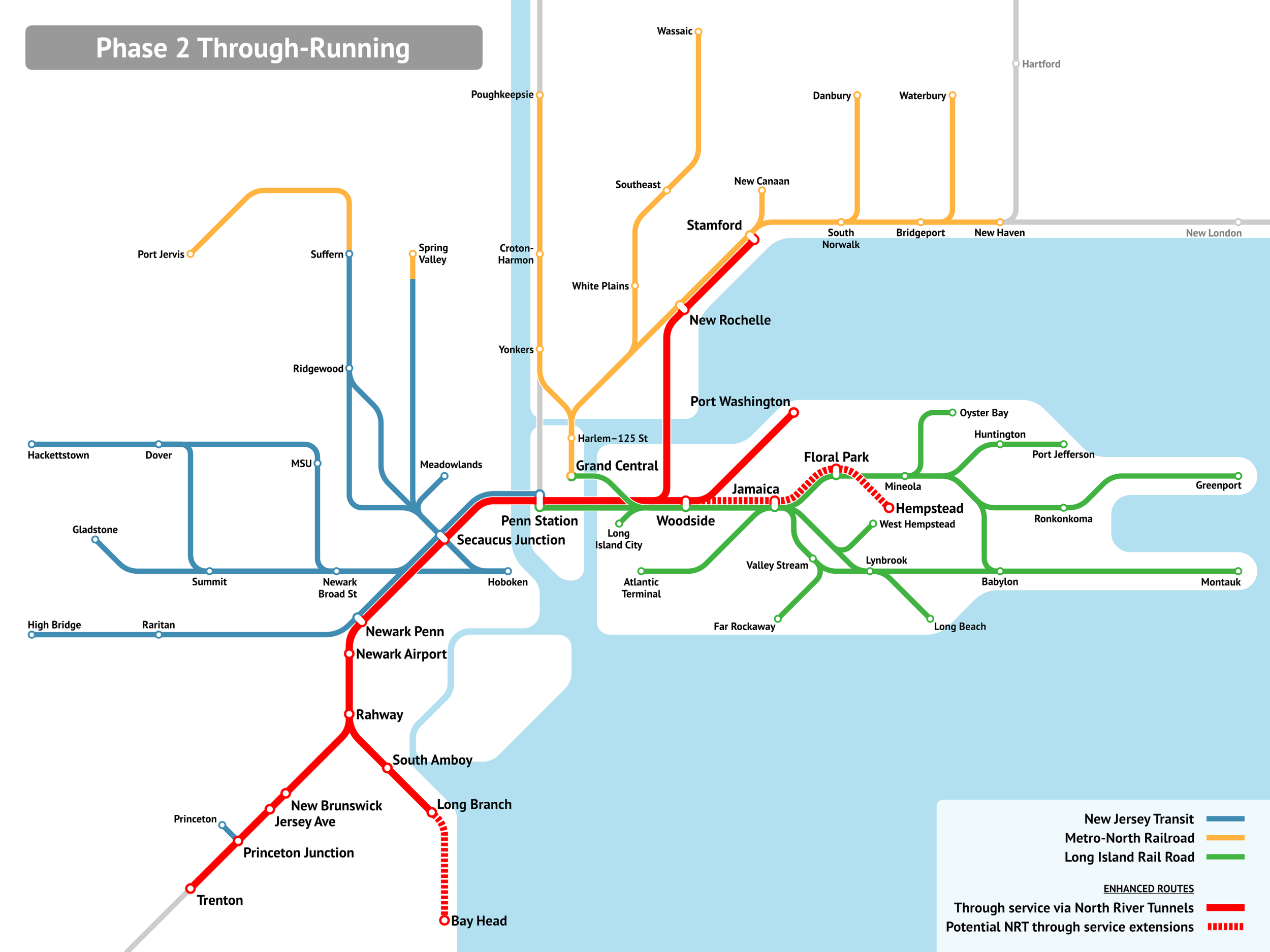
A service diagram of Phase 2 of through-running service. Credit: Kara Fischer, ETA
Service
Phase 2 is designed around three core assumptions: the Gateway tunnel has not opened yet, the NRTs have not finished rehabilitation, and all NJT trains on the NEC and NJCL through-run to MTA territory. With enough lead time from 2025, the MTA and NJT will have bought sufficient equipment to expand through-running all the way from Trenton and Long Branch (or even Bay Head) to MTA territory.
As the expected traffic on PSA is much less than the current NJT traffic on the NEC and NJCL, trains should also through-run to one or more local LIRR branches. Local service is to be preferred over express service—as with the choice of the local NEC service in Phase 1—as city residents and inner suburbanites are likelier to have travel needs crossing Manhattan than residents of outer suburbs. When the MTA evaluates which of its branches are through-ran, it should evaluate the cost, reliability, and potential ridership impact of the chosen branches.
On the track level, the Port Washington (PW) Branch is mostly isolated from the rest of the LIRR network and has simpler merges with the NEC, so it’s the NEC’s natural pair that will minimize conflicts, which increases reliability over that of branches running through Jamaica. It is also relatively short and parallels the extremely overcrowded 7, making it a logical choice for frequent local service. Flushing is also a growing job center, and this connects strong non-core CBDs like Newark and Flushing together. One drawback is that past Great Neck, the line is single-track, severely limiting frequency. Most ridership is at Great Neck and closer in, so short turns would work well, but infrastructure may have to be built to enable this service level.
It’s also useful to study sending Main Line local trains to the LIRR branches serving Jamaica. The parallel E and F are also extremely overcrowded, and this ties more of the LIRR into the through-running network, including JFK via the AirTrain, and makes for more convenient transfers between through-running trains and terminating East Side Access (ESA) trains. However, the tracks would not be as neatly segregated between through-running and terminating trains, which would compromise reliability as many more services interline. Thus, trains should only through-run via Jamaica if the LIRR grade-separates the surrounding interlockings.
We would recommend through-running 12 tph to LIRR, with 6–12 tph on the PW Branch and 0–6 tph through Jamaica to Hempstead.
Rolling Stock
The region should pursue procuring a common EMU, the M10, capable of running on all types of electrification in the region. With normal lead times on rolling stock, if the decision is made in 2025–26, then trains will already start running in the 2030–32 timeframe, and most certainly before all four Hudson tunnel tracks open in 2038. We sketched out the requirements in detail in our recent piece on MTA commuter rail rolling stock procurement. The Momentum proposal by Nolan Hicks is similar.
The M10 would be an EMU similar to the current dual-voltage M8, but would instead be tri-voltage, using a 25 Hz transformer. The M8 does not have such a transformer because it would have added too much weight (the lower the frequency an AC transformer must handle, the more it weighs). However, under the FRA’s 2018 alternative compliance rules, far lighter trains than are traditional in the US are now legal, in line with European trains. Whereas a single M8 car weighs 65 metric tons, a Stadler FLIRT or Siemens Mireo in Germany with an even heavier 16.7 Hz transformer only weighs about 40. Boarding and alighting times are also critical, primarily at Penn Station but also elsewhere on the network, so the M10 should be further optimized for this. This can include wider aisles with two-abreast seating instead of three, wide doors, and/or more doors per train. These doors can also include gap fillers similar to the new Acela trains and Brightline Florida’s trains.
Everything the MTA and NJT should want from regional rail rolling stock—25 Hz compatibility, high platforms, loading gauge, and similar features—is available within the European supply chain, including its American transplants. This means that trains can now be procured with far fewer customizations, reducing costs and lead times. Additionally, other Northeast agencies could find these units useful, and a joint procurement could further lower costs.
Furthermore, when Gateway opens and NJT service to Penn doubles, they will need to order a lot more trains, and LIRR still hasn’t bought enough trains for the promised ESA increase in service. The M10s do not need to replace any trains early; they will be a natural part of the procurement cycle.
Infrastructure
As through-running ramps up in Phase 2, infrastructure investments in reliability are critical.
In particular, three NY State projects need to be prioritized for Phase 2, two of which are in New Rochelle:
Grade-separating the New Rochelle junction (Shell Interlocking, or CP 216) to permit grade-separated movements to and from the Hell Gate Line, which will increase capacity, improve reliability, and reduce scheduling conflicts.
Rebuilding New Rochelle station with platforms on all 4 tracks to permit transfers between terminals.
If through-running over the PW line, construction of short-turn infrastructure to enable running 6–12 tph. Great Neck and Bayside are the two busiest stations on the line and also the best positioned to cheaply add short-turning to. At Great Neck, this could entail new switches from the eastbound (layup) track, while layup tracks in Bayside Yard or a pocket/third track near the yard would help as well (see Appendix 2 for more detail).
If through-running over the Hempstead Branch, the only local branch sufficiently grade-separated through Jamaica, then Queens Interlocking near Elmont must also be grade-separated. This would likely cost several hundred million dollars. Through-running only on the PW line is likely more cost-effective in terms of infrastructure at this stage.
We are uncertain about the cost of the two aforementioned New Rochelle projects, but judging by already in-design projects listed below, we project it to be $500 million. This can be funded out of the state’s $1.3 billion share of Penn Reconstruction, which was recently rescinded as part of USDOT’s takeover of the project.
Several projects in New Jersey are also critical for reliability:
The $500 million Mid-Line Loop. Many through-running trains will terminate at Jersey Avenue or New Brunswick, so this is critical to turn through-running trains quickly and reliably.
The $300 million Hunter Flyover project, grade-separating the junction between the Raritan Valley Line and the NEC, in order to prevent inbound and outbound trains from conflicting at the junction.
High platforms on the two stations on the NEC and electrified NJCL territory that are still low-platform, Jersey Avenue and Little Silver, respectively. Based on recent NJT high platform projects, this should cost about $60 million.
Replacement of unreliable variable tension catenary with constant tension catenary, as we’ve explained before. Some catenary has already been replaced and more has been funded, for both construction and planning, but some has also been replaced by more variable tension catenary. All of it should be replaced with constant tension catenary, prioritizing higher-traffic sections closest to Penn. This work should be ongoing for completion in Phase 3. Using modern catenary techniques for both new construction and upgrades pioneered by international companies substantially lowers costs relative to recent American projects. One report, dialoguing with European catenary vendors about the conditions of the NEC, pegged at $1 billion for the entire NEC from NYC to Washington, DC. Based on this estimate over the length of NJT territory, this is $600 million.
The electrification of the approximately 14-mile remainder of the NJCL. Diesels are fundamentally less reliable, so diesels should not touch the through-running lines. If not electrified, any unelectrified sections would have to use a shuttle with a forced transfer. Based on inflation-adjusted international costs and the cost of wiring the NEC from New Haven to Boston, the cost of this project should be about $100 million.
As an alternative to adding 25 Hz support to the M10 fleet, the electrical feeds on the NEC and northern NJCL may be modified from 25 Hz to 60 Hz.
We highlight one additional suite of required projects in NJ: high platforms at all platforms that can take EMUs. Today, there are 69 low-platform stations on the Morris and Essex (32), Montclair–Boonton (14), Raritan Valley (14), NJCL (8), and NEC (1) Lines, of which 42 are not yet funded for high-platform conversion. Converting them, at $30 million each, has all of the following benefits:
Greater reliability.
Accessibility for ADA, strollers, and passengers with luggage.
Faster boarding and alighting, even by able-bodied passengers, making trips faster.
Compatibility with both the MTA’s existing EMU stock, which can only serve high platforms, and the M10, which will still only be able to serve high platforms. To allow a train to serve low platforms requires trapdoors, which are atypical on EMUs and add weight, complexity, and costs.
Phase 3: Through-Running for Gateway
The opening of the Gateway Tunnel allows NJT and Amtrak to provide a total of 48 tph across the Hudson. The 48 tph comprises through-running 24 tph in the NRTs and 24 tph in the Gateway tunnel terminating at Penn on lower-numbered tracks (1–6), which will lack access to through service to MTA territory.
The MTA, NJT, and Amtrak must pay utmost care to the service plan and coordinate infrastructure decisions with timetabling. The service plan we call for—terminating 24 NJT tph on 6 tracks at Penn Station and 18–24 LIRR tph on 5 tracks, and running 24 tph through on 10 tracks—is not unusually difficult, but does require delicate attention to system reliability and the service pattern. To do this, NJT is already planning to use Gateway to reduce the system’s branching complexity, as detailed below in the service section.
The infrastructure requirements cost more than in Phases 1 and 2, but much less than the Gateway Tunnels. These total about $3 billion, with only about $400 million in New York, and the rest in New Jersey, of which the largest is the $900 million Portal South Bridge project, completing four continuous tracks between New York and Newark.
An independent study by London Bridge Associates, commissioned by the Gateway Program Development Corporation, suggested that in-service rehabilitation of the NRTs is possible before the new tunnels are completed. Moreover, investigative reporting by Michael Aronson in the New York Daily News finds Amtrak only shuts down one of the two tunnel tubes for weekend-long maintenance once every three months, even though the timetable is written to facilitate single-tracking every weekend. It is likely that if Amtrak were to engage in a full shutdown of one tube every weekend, it would be able to complete the required rehabilitation without the three-year period allocated for a long-term shutdown after the new tunnels open. Therefore, it is likely possible that Phase 3 can begin in 2035, as soon as the Gateway tunnels open, rather than in 2038.
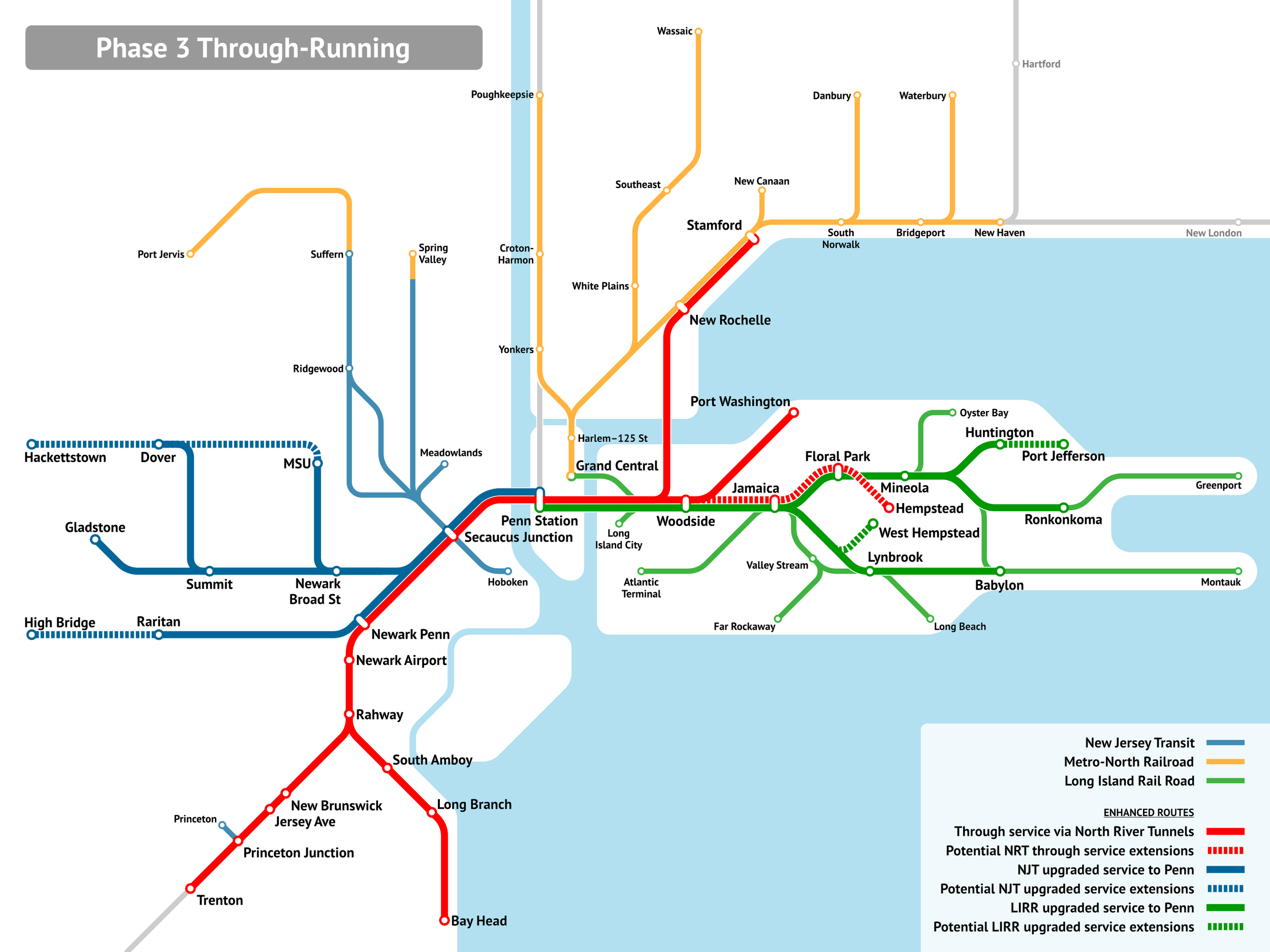
A service diagram of Phase 3 through-running service. Credit: Kara Fischer, ETA
Service
Service reliability is the driving force behind service decisions in Phase 3. Trains can run two minutes apart, but on a complex mainline rail network, this never translates to 30 tph of capacity on a double-track system, because trains sometimes get delayed or even canceled. On a subway system, if a train is delayed then the entire line just runs slightly behind schedule. On a highly-branched mainline rail network, however, each train has a separate identity, so if a train is canceled or seriously delayed, the other trains can’t easily substitute for it. Therefore, the key here is to simplify the system, reduce delays, and limit delay propagation.
It is fortunate that the Gateway Tunnel is already planned to come with service changes that greatly simplify service. Whereas today there are Amtrak trains and five NJT branches running through to the NRTs, the post-Gateway plans call for separation, so that Amtrak and the two NEC branches stay in the NRTs and the other branches move to the Gateway tunnels.
With this scheme in place, the four-track trans-Hudson system should be run as two separate networks, one using the NRTs (including Amtrak) and one using Gateway. The Gateway tunnels, designed to reach the southernmost (lowest-numbered) Penn Station tracks, cannot through-run, unless a further tunnel is built from Penn Station to Grand Central or to Sunnyside. The NRTs should through-run: Amtrak trains along the NEC, and NJT trains to PSA or a LIRR branch, both via the East River Tunnel (ERT) tracks 1 and 2 under 32nd St. Finally, the ERT tracks 3 and 4 under 33rd St cannot through-run unless a tunnel realignment to the Empire Connection is built, and LIRR trains using them will need to keep turning at West Side Yard (WSY).
These three separate systems—NJT terminating via Gateway, NJT-MTA running via the NRTs and ERT tracks 1–2 under 32nd St, and LIRR terminating via ERT tracks 3–4 under 33rd St—will not have more complexity than most existing through-running commuter rail systems in the largest European cities. We expect the number of branches per system to be as follows:
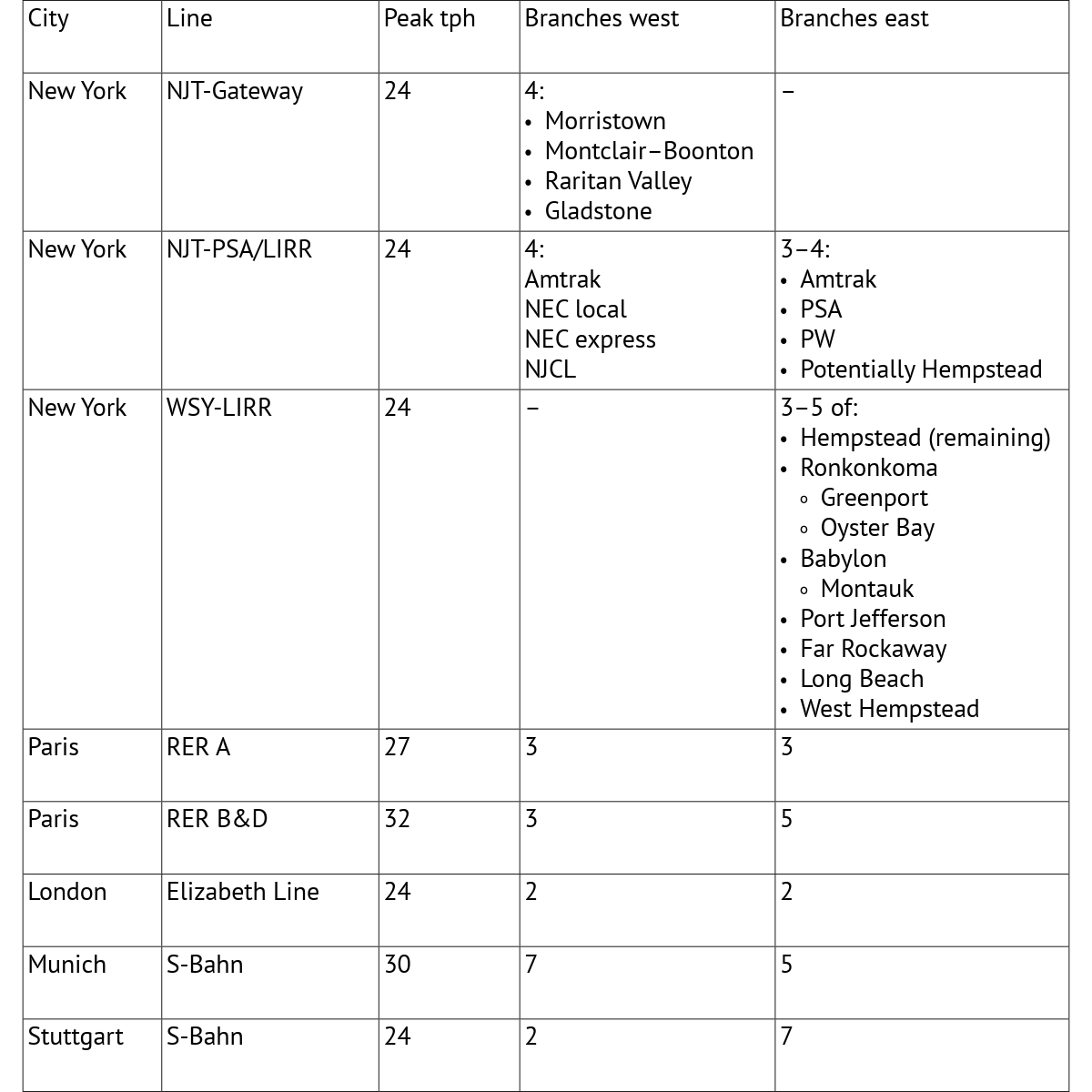
With the Gateway Tunnel opened and the branch assignments as above, we don’t expect more network complexity than in the European examples, only longer lines. This allows for high reliability and capacity, because if a train goes out of service, it’s easier for the next train on the same line to substitute for it while keeping the sequence of train arrivals in the central tunnel intact.
Rolling Stock
The rolling stock required for post-Gateway service is the same tri-voltage EMU required for Phase 2, the M10. However, as throughput across the Hudson is expected to double, many more such trainsets are required. LIRR still needs more trains for its promised increase in service to Manhattan for ESA, so we estimate that on the order of 700-1000 new cars need to be ordered region-wide.
The procurement of rolling stock should begin very soon. The opening date of the Gateway Tunnel is already set for 2038 (including refurbishment of the NRTs) and the required specs for this rolling stock are the same as in Phase 2. The MTA and NJT should ensure that enough trains come online by the early 2030s for Phase 2 service and that additional sets are delivered by 2035 or 2038 for full Phase 3 Gateway service.
Infrastructure
By far the largest infrastructure project in this phase, by cost, is the already-funded Gateway tunnels. However, several additional projects, all much less expensive, should be completed:
High-level platforms for all remaining stations in electric territory. We expect this to cost $1.3 billion based on NJT estimates for already funded stations.
The project started in earlier phases to upgrade to reliable constant tension catenary should be completed.
The $900 million Portal Bridge South—the last remaining unfunded core component of the Gateway Program—enabling four tracks’ worth of capacity from New York to Newark.
Queens Interlocking flyover, of similar complexity to Hunter, which NJT estimates at $300 million.
At the end of this phase, expansion of electric territory with new overhead catenary should be well underway systemwide, including on newly through-running MTA lines. Future phases of a through-running program should be explored in this timespan. These might include concepts such as a connection from Penn Station’s tracks 1–5 to Grand Central and other through-running tunnels from our Modernizing Commuter Rail report.
Phase 4: Expanding Through-Running with Future Infrastructure
For decades, organizations dedicated to improving regional connectivity (ETA, ReThink NYC, RPA, and Tri-State Transportation Campaign among them) have been proposing additional through-running trunks in New York. In Phase 4, we envision extending the service through the Gateway tunnels eastward to create a second through-running trunk. Various experts (David Peter Alan of Railway Age, and Bob Previdi, Mysore Nagaraja and Howard Sackel’s joint proposal) have also floated using existing provisions to build new tunnels connecting Penn Station's southernmost tracks eastward to Grand Central Terminal (GCT) or Queens. Either option would create new one-seat rides, enhancing system connectivity. This goes beyond the scope of the original Gateway program, but making such a vision a reality requires that planning start now.
Tracks 1–5 at Penn Station have provisions to be connected eastward. When Penn was being built in the 1900s, the pillars supporting the buildings east of the station were located to allow two additional tracks to the east. The MTA and NJT should build out these tracks to allow for additional service from points east to Penn Station and provide through-running from Gateway. Because of the complexity of this project, the MTA and NJT should begin planning it this decade, so that construction can begin in the 2030s and the tunnels can open in the 2040s.
The tunnels east of Penn Station can go to one of two destinations: Grand Central or Queens. A Grand Central connection would link to the lower level of the existing Grand Central Terminal, which has provisions for extension, enabling trains to go up Metro-North to the Hudson, Harlem, and New Haven Lines. A Queens connection would link to the LIRR Main Line and permit through-running to the entirety of the LIRR, except for ESA or Atlantic Terminal trains.
We prefer the Grand Central option over the Queens option. It would more than double the number of jobs within the stations’ walksheds, allowing for far more one-seat rides. It would enable running more rush-hour Metro-North service. And it would also take tons of riders off of packed platforms at Penn Station, Grand Central, and Times Square, both on commuter rail and the subway. This would provide modest but noticeable improvements to subway capacity, and critically, relieve the southern Penn platforms, as a substantial number of riders will continue to Grand Central. In contrast, the Queens option does not offer primary or secondary capacity improvements, as LIRR already has ample capacity into Manhattan with service to both main stations via the existing tunnels and ESA. Nor does it provide a path from the Harlem Line to Penn Station, which only the GCT option does.
That said, we believe the MTA should study both options seriously and carefully. The study must consider the service running through each option. For the GCT option, this means figuring out which Metro-North branches through-run and which terminate on GCT’s upper level. In both cases, surface work will be required.
At the same time, the MTA should plan for additional through-running between the Hudson Line, Empire Connection, and the ERT tracks 3–4 under 33rd St. The PSA plans included an option for PSA West, connecting the Hudson Line to Penn Station via the Empire Connection. We favor reactivating these plans, including a short two-track realignment of the Empire Connection to northern tracks at Penn. With these changes, Penn Station would have 3 pairs of tracks on both sides, and every pair on one side would be able to through-run to a pair on the other side with no conflicts.
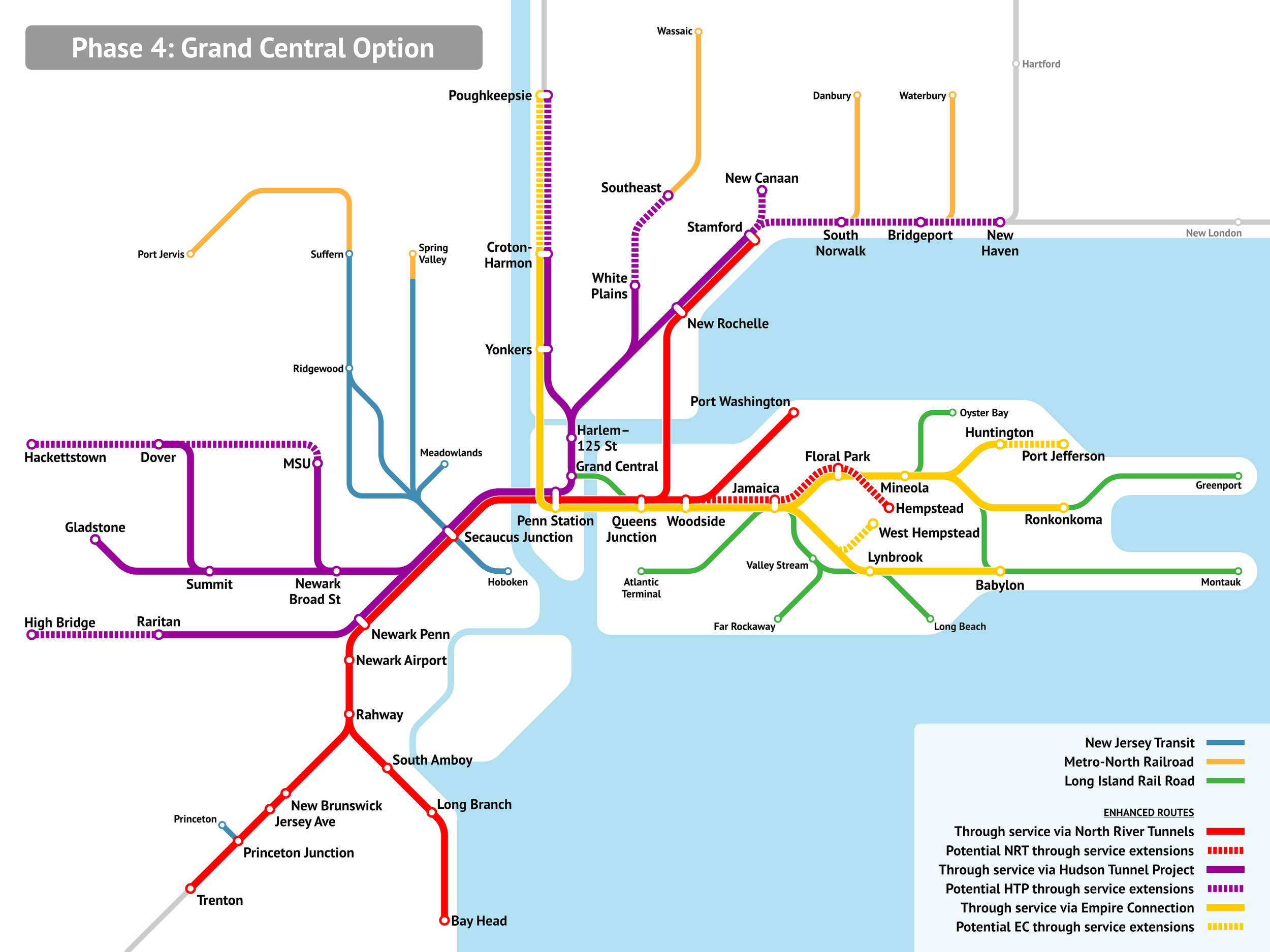
A service diagram for Phase 4 of through-running service. Credit: Kara Fischer, ETA (Note: This version has been updated for clarity from the original PDF version)
Service
Service throughput from New Jersey to Penn Station remains 48 tph in this phase. The lines using the Gateway tunnels no longer terminate, but instead through-run via GCT or Sunnyside.
If GCT is chosen, it eliminates many conflicting moves in the lower-level throat. There are multiple choices for which Metro-North lines to through-run and which to terminate. The ideal option from the perspective of passengers is to through-run all locals and terminate the express trains. However, on the Harlem Line, this is difficult because of extensive track-sharing between local and express trains. If terminating and through-trains share tracks on a branch, then delays from one line cascade to the other and the system gets too complex. Alternatively, the entire Harlem Line could through-run, with some additional New Haven or Hudson Line locals.
If the Queens option is chosen, then the difficulty is with running enough LIRR service to fill all tunnels: 96 tph. Under this option, there would be eight tunnel tracks from Manhattan (four-track ERT, ESA, and this new tunnel) connecting to eight tracks in Queens (PSA, PW, four-track LIRR Main Line), which could overserve the New Haven (44 tph) and Port Washington (24 tph) lines.
Regardless of which option is chosen, additional service is required for LIRR–PSA West through-running. The question of which LIRR branches connect to which through-running tunnel is uncertain, and the MTA should study all options in the remainder of this and the next decade. In any case, large service increases on the local LIRR branches (Port Washington, Hempstead, Far Rockaway, and Long Beach) are warranted, with trains at least every 10 minutes in the inner suburbs.
Rolling Stock
As with Phase 3, Phase 4 does not require further changes to rolling stock, merely buying more of it.
One possible exception is Phase 4’s LIRR–PSA West, which would pair the bottom-contact third rail of Metro-North with the top-contact third rail of the LIRR for through-running. The newer LIRR and Metro-North trains (M7 and onward) can be reconfigured in the shop to support either kind of third rail, but not currently while in motion. Thus, either the M10 or future rolling stock must support both simultaneously, or the Hudson Line must be re-electrified with catenary. The latter would allow cheaper catenary to be used for new electrification, and it would also allow Amtrak to share it more easily.
Infrastructure
Both the Penn Station-Grand Central connection and the new tunnel to Queens we propose require a tunnel with steep but tractable grades. Either tunnel would have to ascend at a 2.7% grade from Sixth to Seventh Avenue to clear subway lines and the PATH, and the Grand Central tunnel would have to briefly ascend at a 4% grade near 42nd Street under Park Avenue to thread between the 6 and 7 lines. Many lines served by EMUs globally have 4% grades, and the NYC Subway has a 5.5% ruling grade. The approach to the lower level of Grand Central has a 3% grade and the approach to Grand Central Madison has similar grades.
Regardless of which option is chosen, the New Jersey network requires additional minor surface upgrades to improve reliability. Flat junctions between rail lines are no longer acceptable for the level of service envisioned at this stage. While the most difficult flat junction, Hunter, would need to be grade-separated in Phase 2, several more projects are required here:
Grade separations of junctions:
Mott Haven Junction, where the Hudson Line meets the combined Harlem and New Haven Lines. This is more expensive than other junctions as it is in NYC and fairly constrained.
The Kearny Connection, which forces the inbound and outbound Morris and Essex trains to cross each other at-grade.
Roseville Junction from the Morris and Essex Lines to the Montclair–Boonton Line in Newark.
Double tracking of lines that can be left single-track in Phase 3 but would be too unreliable with full through-running:
The Gladstone Branch.
The outer Port Washington Branch (east of Great Neck).
The Montclair–Boonton Line between Montclair State University and Dover.
Quad tracking of the inner 6 miles of the Raritan Valley Line, to fully separate passenger and Conrail freight trains on the Lehigh Line.
Upgrade of Summit Yard to allow more reliable turnbacks.
Newly through-running sections of MTA lines, like the upper portion of the Hudson line, should be electrified with catenary.
Separately, the MTA should construct an infill station at Sunnyside Yards in phase 3 or 4, which we have called Sunnyside Junction or Queens Junction in past reports, permitting quick transfers between Metro-North PSA trains and LIRR ESA trains. The MTA previously estimated a different station at Sunnyside at $490 million. This station would provide regional rail service to dense areas that get bypassed and make transfers possible that would require trips to Manhattan otherwise.
Furthermore, in grade-separating Mott Haven Junction, an infill station should also be explored. This would be extremely difficult to fit, if even possible, but the benefits of a seamless subway transfer at 149 St-Grand Concourse to relieve the IRT are substantial, so it should be at least studied.
Penn Station Renovation
Many concepts for Penn Station have been proposed over the years. We will not analyze any headhouse proposals since the form it takes is irrelevant to station operations so long as it furnishes sufficient egress capacity. We instead raise several proposals at the track and concourse levels, which we find merit at least serious study.
We strongly prefer an approach that minimizes construction and exhausts all the potential of the station as it is currently configured. We have simulated crush-loaded trains simultaneously discharging and boarding, and found that Penn Station's platforms have the capacity to handle the service that we propose to run by Phase 3. There are multiple ways to improve this further, however, providing extra breathing room, and these can be done independently.
The least invasive way to improve platform egress capacity is by expanding and improving the vertical circulation on the existing platforms:
New vertical circulation elements (VCEs: staircases, escalators, and elevators) from platforms 1 and 2 to the West End Concourse.
Extension of the Central Concourse to track 1.
Replacement of VCE enclosures to reduce wasted space. Many VCEs at Penn have thick walls, which, if not load-bearing, can be removed or replaced, like how new stairs on the subway are open beneath and on the sides, and how elevators have thin glass walls.
Reopening the Gimbels Passageway connecting Penn Station and the Herald Square subway/PATH complex. While this doesn’t improve platform-concourse circulation, it will significantly improve connectivity throughout the area.
Our simulation only looked at the platforms and VCEs, so interlocking improvements may also be necessary in Phase 3. The current Penn interlockings are highly complex, with many switches (each a point of failure) and possible routings. This reduces speed, and thus capacity, within the interlocking, as more switches mean shorter, slower switches, and the complexity means signalling struggles to safely allow maximum geometric speed. The more the interlockings are streamlined, the more platform time is available at the same headway. Thus, we propose:
Replacement of outdated circular secant switches with more reliable spiral tangential switches, which trains can run over more smoothly and at around 50% higher speeds, within the same footprint.
Simplification of the interlockings and reduction of the number of switches while preserving sufficient parallel movement capabilities and flexibility.
Removal of the diagonal platform to allow greater flexibility in interlocking design.
Signalling that can support maximal use of the interlockings.
At a more invasive level, there are options at the platform level to ease capacity constraints:
Addition of tail tracks past tracks 1–4 as far as 5th Av to increase those tracks' capacity while future-proofing for one of the through-running tunnels proposed in Phase 4.
Lengthening of the platforms serving tracks 1–4 to the west and/or east as underground space and grade constraints for eastward connections permit.
Paving over certain tracks to widen platforms.
Addition of a two-track island platform south of track 1 under 31st St. This has been proposed by NJT as Platform A and can avoid historic structures like the St. John the Baptist Church. This is substantially more costly than other projects on this list due to the structural changes involved and volume of digging required, but still an order of magnitude cheaper than the full Penn Expansion.
If stakeholders decide to proceed with any of the aforementioned projects, especially if coupled with a headhouse, one of the first things that should be evaluated is how Madison Square Garden and 2 Penn Plaza affect the cost and sequencing of such a project. Most of those two buildings' support columns run through valuable space at track level. While we do not advocate relocating the Garden immediately, it is likely beneficial enough in the long term to warrant exploring, even partially at public expense. The cost and time savings from not having to work around an active arena and office building may well offset a public contribution to replacement facilities. If the Garden is moved, the closest potential location is likely right across 7th Ave between 32nd and 34th Streets, where the Hotel Pennsylvania once stood and several shorter buildings now stand, just south of the historic Macy’s department store.
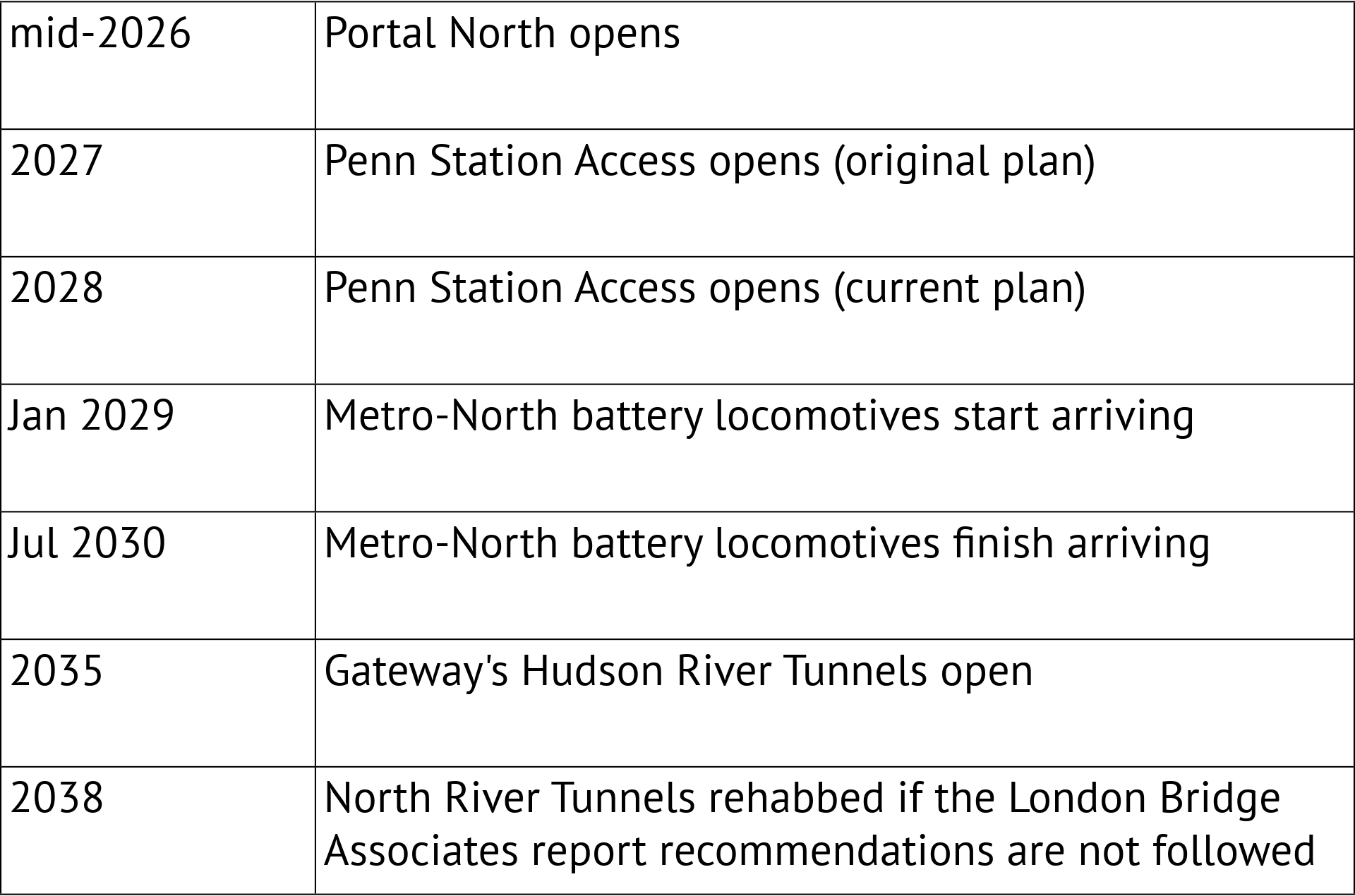
Appendix 1: Project Timeline
Appendix 2: Port Washington Turning Capacity
The two busiest stations on the PW line are Bayside and Great Neck, which are also the best positioned to cheaply add short-turn infrastructure to. At Great Neck, the two tracks continue for about 3750 ft before narrowing to one track. This eastbound (EB) track can be used to short-turn trains, and all that is needed is a westbound (WB) switch from the EB track to the WB track. This track should also be able to hold a few 10-car trains, so multiple westbound switches would also allow for about three simultaneous layups, further increasing short-turn capacity. With 5-min dwells at Great Neck and (up to) 10-, 15-, and 20-min turns at the three layup slots, this should allow turning 9 tph at Great Neck, with 3 tph single-tracking to Port Washington.
At Bayside, there is a yard soon after the station, just long enough for a 10-car train, and extra width on the northern side of the ROW past the yard as well, up to 221st St, about 1600 ft long (including the yard). Both present opportunities for short-turning. Layup tracks could be added to the yard, although this would require a crossing move from the EB track into the yard and some of the equipment currently in the yard to be moved. Alternatively, the ROW could be widened to three tracks in this 500 m stretch, with the middle track being a pocket track for short-turning. This eliminates any crossing moves, although it requires the WB revenue track to be switched to the new third track.