LIRR Work Rules: Vestiges of the Steam Era
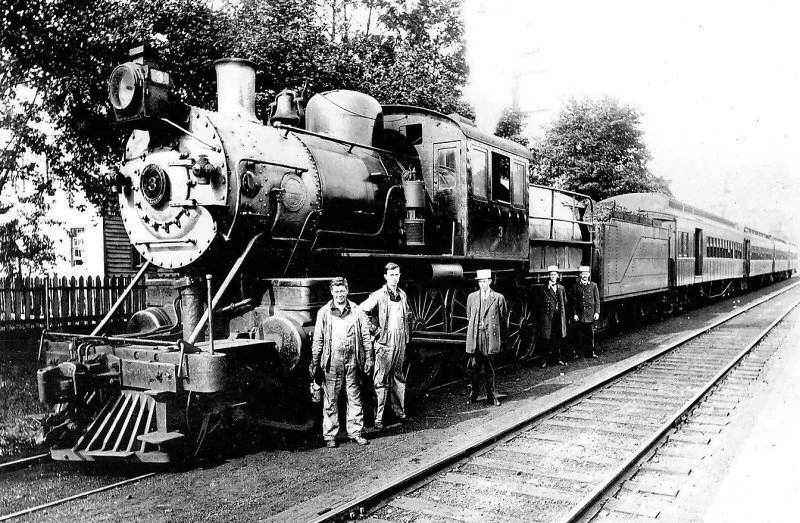
Workers in dirty clothes in front of an LIRR steam locomotive in 1912. Dan V. Whaley collection, Dave Keller archive via trainsarefun.com.
On May 16, five Long Island Rail Road (LIRR) unions representing 3,500 of the railroad’s 8,000 workers went on strike. Judging by the statements made by management and the unions, there is a real possibility that this strike could last for some time, and have major repercussions for future LIRR service.
In a nutshell: Management is open to the union’s wage requests, but is demanding changes to work rules as a precondition. To agree to the higher pay rise, management is demanding a series of changes in work rules.
To understand the issues at play, it is critical to understand the context for train engineers’ work rules: they are unique both globally and even in the tri-state area, and thoroughly outdated. These work rules are an albatross that remain a significant impediment to long-term service increases and additional event service on Long Island.
The primary work rules in question are for train engineers, represented by the Brotherhood of Locomotive Engineers and Trainmen (BLET). Regardless of how many hours they work in a given shift, BLET workers are entitled to an additional 8-hour shift’s pay if they do any of the following:
Drive both a diesel train and an electric train the same day
Go from yard service to running a revenue train
Work on special service and regular service, for example if an engineer’s work for the train comprises a regular Port Washington Branch run and also a special service baseball train to Mets-Willets Point.
Remarkably, this benefit is for each action performed, so a BLET worker could theoretically net three shifts’ pay for a single 8-hour shift. These payments effectively boost engineers’ salaries by an average of 15%.
Notably, as MTA inspector general reports dating back two decades along with other MTA reports highlight repeatedly, Metro-North has largely shed rules that are vestiges of steam engine operations, when changing between electric and steam unexpectedly could stain an engineer’s clothing requiring the purchase of another set. While there are operating differences between diesel and electric equipment, they neither stain clothes nor are significant enough to warrant such a rule. In fact, ETA is not aware of any other railroad that still has a similar pay setup anywhere in the world.
Globally, mainline passenger railroads like the LIRR vary dramatically in efficiency. The most efficient operations are not found in the United States. The lower the ratio of peak service to midday service is, the easier it is to schedule crew, as there is much less downtime and need for split shifts. With low ratios found across Europe and in Japan, which usually have a peak-to-base (midday) service ratio of 2 or less, railroads can get between 700 and 900 annual revenue-hours per train driver. American railroads are significantly peakier—the LIRR has a ratio of about 3.5 and Metro-North about 4—and as a result have more difficult time scheduling crew, with more dead time, including deadheading, turnback time, or commute time as workers have to report to different bases on different days. As a result, the LIRR and Metro-North both get only 500–600 hours of revenue service per driver, compared with 700–900 hours on the European operations for which we have data, even though Americans get less vacation time than Europeans.
Indeed, we have the following operating costs for the major American commuter rail systems:
| Railroad | Cost/year | Car-mi/year | Car-hours/year | Cost/mile | Cost/hour |
|---|---|---|---|---|---|
| LIRR | $2,212,613,620 | 78,229,282 | 2,600,595 | $28.28 | $850.81 |
| Metro-North | $1,705,088,620 | 64,017,201 | 2,038,665 | $26.63 | $836.37 |
| NJ Transit | $1,377,933,850 | 57,811,861 | 1,800,540 | $23.83 | $765.29 |
| Metra | $988,718,286 | 44,110,638 | 1,506,554 | $22.41 | $656.28 |
| MBTA | $569,535,378 | 25,204,170 | 893,191 | $22.60 | $637.64 |
| SEPTA | $331,401,351 | 17,657,718 | 896,821 | $18.77 | $369.53 |

Operating cost per hour.
SEPTA’s low operating costs are a combination of good practices that ETA has outlined elsewhere such as all-electrified service and a peak-to-base ratio of about 2.5 rather than 4, and more flexible labor arrangements. The 3.5-month SEPTA strike in 1983 led to changes in labor contracts, giving management far-reaching rights, not all of which it has exercised in the decades since. If the LIRR had Metro-North’s per-mile operating costs, it would save $130 million per year. If it had SEPTA’s, it would save $740 million per year.
Regardless of what is done with the labor dispute, therefore, running more off-peak service would increase efficiency. A large increase in midday service would only require a modest increase in the number of train engineers and conductors, as scheduling could convert dead hours into hours spent working a passenger-carrying train. Moreover, the extra operating costs would be balanced out by higher revenue as passengers take more off-peak trips: replacing hourly trains to each of Grand Central and Penn Station with trains running to each destination every 20 or 30 minutes would significantly boost ridership. For example, after much advocacy by the Boston based group TransitMatters, the MBTA increased off-peak frequency in 2021 during early pandemic recovery, running suburban lines every half hour. It was rewarded to the point that now it is the only major American commuter rail network with more ridership now than in the late 2010s.
Requiring extra pay for one engineer operating on both diesel and electric trains acts as a barrier towards increasing off-peak service. Many diesel branches genuinely require fewer trips, as the population density near them is lower than in electric territory. Dedicating engineers to these branches results in inefficient dead hours where engineers aren’t serving riders. Enabling more of these engineers to operate electric trains off-peak without penalty would serve as a cost-effective way to increase frequency where it could drive the most ridership.
The current arrangement also makes special event trains prohibitively expensive. As a result, the LIRR runs special trains only for the largest events. Providing more special service to the events regularly held at Willets Point and Elmont would increase the number of attendees using transit, reducing traffic on Long Island.
The last steam train ceased operating on the LIRR in 1955; engineers’ clothes have been safe from coal dust and smoke ever since. Yet LIRR unions are striking in part to preserve rules that have been irrelevant for over half a century, at the cost of preventing the LIRR from modernizing operations and increasing service. The railroad’s goal should be to not only to recover pre-COVID ridership levels but also to greatly exceed them, which requires modernizing its operations to unlock even more all-day ridership going forward. Bridging that gap, and ensuring the MTA remains on solid financial ground without increasing pressure on riders or taxpayers, requires fundamental changes in unions’ expectations and LIRR governance alike.