
Statement on the FRA’s Phase I Report
The Federal Railroad Administration (FRA) released a Phase I report on July 15, 2026, regarding Penn Station capacity after the completion of the Gateway Tunnels and Penn Transformation. After years of thinly-sourced studies from the railroads all but dismissing through-running out of hand, ETA is pleased to see this new work from the FRA finding that a combination of through-running, minor operational changes, and circulation improvements can significantly increase capacity within Penn station’s existing footprint for the 350,000+ daily riders at Penn Station.
One major win in this report is detailing a three-section approach to managing Penn Station, where the northern and southern portions continue to handle terminating trains, while the central section handles through-running Amtrak and commuter rail trains. ETA has championed this design as a means of optimizing the station’s capacity by reducing conflicting train moves between trains entering and leaving the station. Additionally, this approach enables staged implementation of through-running without requiring a total redesign of the region’s rail network. We’re glad to see the FRA recognizes the value of this approach, and is adopting it as its suggested station operating model moving forward.
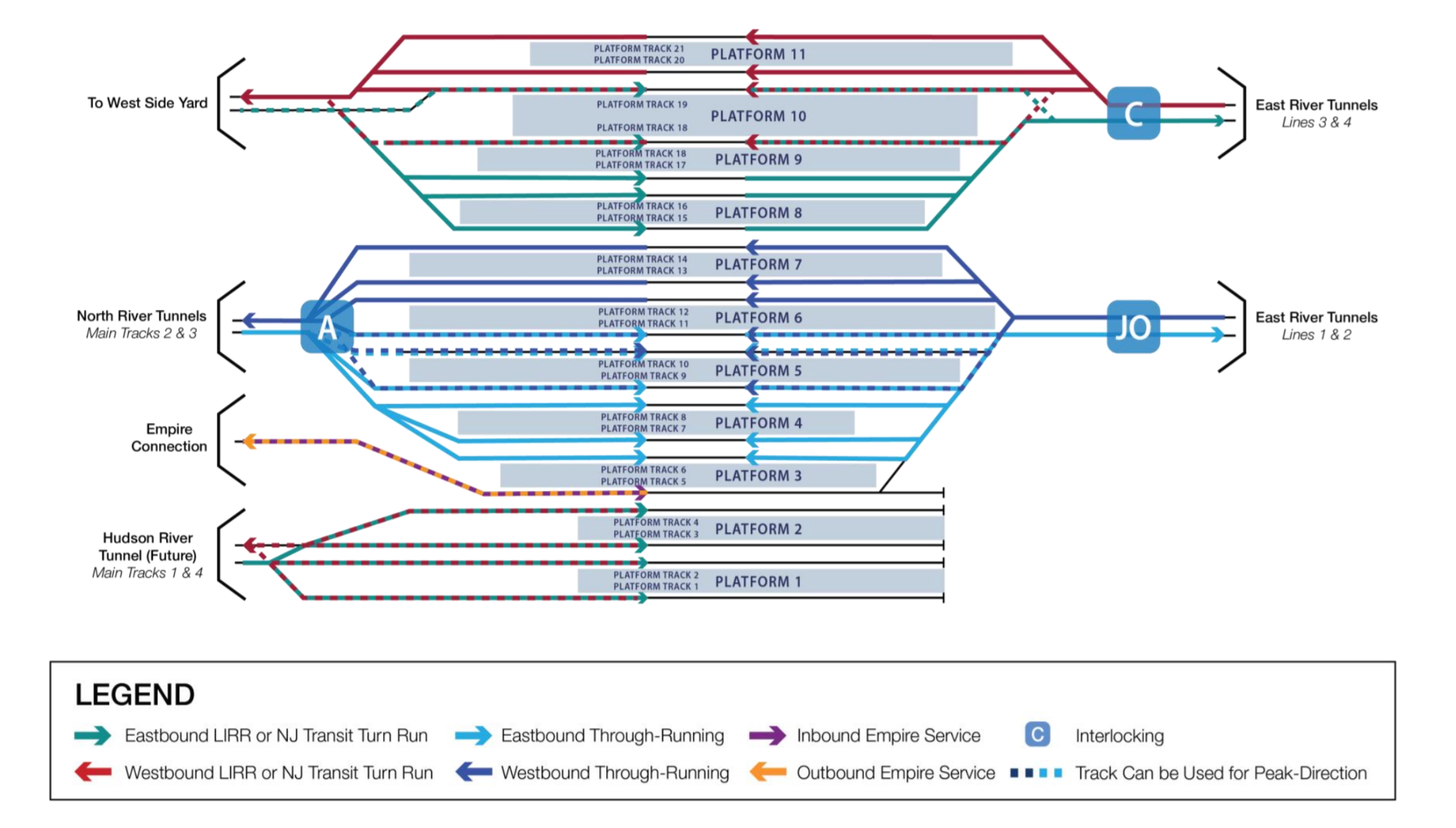
The FRA diagram, similarly to ETA, assigns the northern portion of the station to LIRR terminating trains, the southern section to NJT and Empire Connection terminating trains, and the rest to through-running trains.
However, this report does not yet offer a clear pathway to running 48 trains per hour (tph) under the Hudson, which is theoretically enabled by the Gateway Tunnels. The FRA report only proposes a throughput of 30-32 trains per hour (tph) per direction across the Hudson River. This limitation primarily lies in the premises of the FRA’s report. It makes a set of conservative assumptions about some of the most critical factors: the dwell time requirements, associated passenger flows, schedule reliability, and crew operations of the railroads operating in Penn Station. Those dwells and requirements severely reduce capacity, compared to the throughput in our own analysis, and hopefully the FRA’s upcoming Phase II report which will look at regional infrastructure and operational improvements to improve capacity, on time performance and reliability.
Conservative operations assumptions
The FRA’s report defers to certain dwell time requirements provided by the railroads dating back to December 2013. While this study did correct for passenger flow changes that have occurred due to construction since 2013, it insufficiently discusses other issues with train operations and operational discipline that each add precious time to each train. A serious station plan must include changes such as speeding up turnback and crew change times. As the report notes, a centralized Terminal Operating Plan and a single procedure for authorizing departures and acknowledging signals are must-haves due to the time they would save for all trains.
These operational improvements have precedent, even within the United States. For example, in Philadelphia, SEPTA changes crews in the Center City Commuter Connection, a through-running tunnel, during 3-minute dwells. Decreasing dwell times for through-running and turning trains unlocks significant capacity improvements; we hope Phase II analyzes the full possible extent of dwell time reductions and resultant capacity increases while providing the corresponding cost-benefit analysis and underlying data.
Conservative passenger flow assumptions
Additionally, we suspect maximum passenger boarding and alighting times can be much lower than what the Phase I study finds, based on our previous modeling. Factors that may increase dwell times include requiring passengers to alight and board in separate phases without pre-loading the platform, the lack of advance track announcements, railroads encouraging riders to board only from specific station sections, and trains not leaving the platform until passengers fully clear it. The report mentions most of these as significant bottlenecks, but only assumes they are fixed in its modeling of the proposed super-wide platform. However, it is unclear exactly what assumptions are used for the other platforms. We wish the analysis were clearer about its input parameters, and we hope Phase II drops outdated operating assumptions and runs an updated, transparent analysis.
Optimizations first, construction second
It’s good planning practice to prioritize improving operations as much as possible before embarking on more expensive capital projects. The sequencing of Phase I looking at primarily capital projects with moderate operational improvements, followed by Phase II looking at broader operational and capital improvements, makes it difficult to understand a physically unmodified Penn's maximum capacity.
Instead, we would have preferred that Phase I calculated an upper-bound capacity for Penn assuming all necessary changes to decrease dwells in the station and increase its reliability, with and without Penn Transformation improvements. With this data, it might be possible to scale down some of Transformation’s VCE treatments, saving money without losing necessary capacity.
ETA’s approach
In contrast to the FRA’s approach, our reports have always looked at the whole system holistically, with any changes in Penn Station typically following rather than preceding rolling stock upgrades and small incremental improvements widely distributed throughout the system increasing reliability in order to ensure that delays do not cascade from Boston down to Virginia. The schedule variability and other operational slack that the FRA Phase I report holds as constant we explicitly plan on addressing, at least in part, by the time Gateway opens to provide 48 tph across the Hudson River.
These changes aren’t required to begin operating limited through-running service in the short term. Through-running should begin once Penn Station Access opens and ramp up over time, so the railroads and passengers alike can gain more experience with the concept.
The FRA’s upcoming Phase II Report
Operating changes and capital projects outside of Penn are necessary to increase reliability and capacity, addressing the present-day high variability and low schedule adherence noted in the FRA’s report. This includes electrification, upgrading stations with high-level platforms, and grade-separating junctions, all much cheaper than demolishing a block of Midtown Manhattan. This would provide far more benefits to riders like reduced travel time and increased schedule reliability. We look forward to the FRA’s analysis of these improvements in their Phase II report along with necessary data for ETA and other groups to perform independent analysis.
Conclusion
All in all, the FRA’s Phase I study is nonetheless the most comprehensive publicly funded study so far looking at challenging some existing inefficient operating practices and maximizing the capacity of Penn’s current footprint. It is also a significant step forward in establishing a future Metro North-NJT through-running service. We optimistically await Phase II, which we hope will pave a clear and affordable path forward for 48 tph of trans-Hudson capacity to Penn Station.
The report fortunately makes reference to looking at operating changes within and outside of Penn in its Phase II follow-up. Until those changes are analyzed, Penn’s full potential has not been unlocked.